Elmore Leonard’s 10 tips on writing came up in a talk today. It’s 10 years old, but new to me, so I’m posting it. Plus, I chuckled at the first — into my head popped that elemental cliche “it was a dark and stormy night….” Always good to be able to laugh about writing.
i went yesterday to see a talk by Esther Duflo and Abhijit Banerjee, two MIT economists considered stars in policy realm of global development. They were touting their forthcoming book, “Poor Economics” (Andrei Shleifer, who introduced their talk, cracked that the book was not about the state of the field).
The basic argument is that the poor are not creative people imprisoned by their lack of money, yearning to be set free to build good lives for themselves. No, the poor are like almost everyone else — they want nice things. For instance, Duflo and Banerjee found in their research that when people who make $1 a day increase their wages, they spend 1/3rd of that increase not on more food, but higher quality food. Nor does their research show that the poor are, as Banerjee put it, “capitalists without capital.” Only 15 percent of Mexico’s poor were entrepreneurs in 2002. By 2005, business failures meant only 6 percent of those poor were still operating, and only 1.8 percent had retained the same number of employees.
A survey showed that most poor people — 75 percent — want their sons to grow up to work for the government, either directly or as teachers. Another 18 percent hope their sons will get jobs at private firms. That leaves a tiny fraction who want to see their children become entrepreneurs. Banerjee says the reason is simple: it’s too hard to be an entrepreneur, and too risky. I feel that way sometimes, myself.
It looks like a promising book, and a fresh look at a crucial area of development economics. It’s due out in early May.
One of the students in the Sunday school class I teach wrote as part of an exercise that one thing he brings to the congregation is a good additude. I liked the idea of “additude” so much I asked if he spelled it that way on purpose. It turns out he misspelled attitude. But I intend to adopt it: Additude (n), How a positive demeanor adds something powerful to a group, or a day.
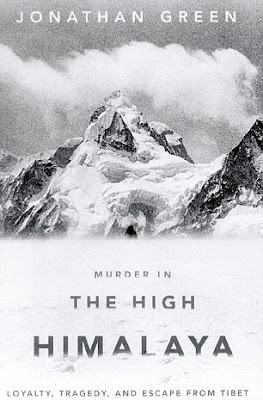
Kudos also to my friends Barry Yeoman and Jonathan Green. Barry won the Arlene Eisenberg Award for Writing that Makes a Difference, for School of Hard Knocks, his piece on the malign nature of some for-profit colleges. Jon’s book Murder in the High Himalaya won for General Non-fiction.
Edmund Wilson (photo to left), the great 20th century critic and writer, was close friends with F. Scott Fitzgerald. Yet of his close friend he said, in 1922, when Fitzgerald was only 26:
Fitzgerald has been left with a jewel which he doesn’t know quite what to do with. For he has been given imagination without intellectual control of it; he has been given the desire for beauty without an aesthetic ideal; and he has been given a gift for expression without very many ideas to express.
I wonder if this line from Tender is the Night is a gentle jab from Fitzgerald at Wilson: “Like so many men he had found that he only had one or two ideas…” [book two, part xi, Tender Is the Night, page 165 of the 2003 Scribner trade paperback edition].
My new word for the week is ‘chiasmus.’ It means, according to the trusty though ragged Merriam-Webster’s New Collegiate I got when I went to college, “an inverted relationship between the syntactic elements of parallel phrases (as in Goldsmith’s to stop too fearful, and too faint to go).” Or, as it was used this week in my American Novel course, to describe how “Tender Is the Night’s” Dick Diver loses his mental stability as his wife Nicole regains hers.
My invented word is “applaudience,” and came from my son Aedan. He wanted appreciation for having finished a piece. “No applaudience?” he said, plaintively.
Shakespeare’s use of language is so beautiful, his scope so fraught with meaning that we miss the brutality of his tragedies. Hamlet, for instance, is a highbrow slasher flick. If Hamlet isn’t inflicting death on somebody, he’s thinking about it. Perhaps strangely, in Stephen Greenblatt’s course last term, we got into the issue of whether Hamlet’s actions at the end of the play suggest something about Elizabethan attitudes towards God’s role in life. Hamlet is a man of faith who has faith in nothing, least of all himself. He prefers murder to turning the other cheek, and suicide to hope. We discussed in class what the idea of ’special providence’ meant to Shakespeare, based on these lines from Act V, Scene ii, where Horatio is trying to talk his friend Hamlet out of a duel meant to leave Hamlet dead.
Hamlet replies:
[T]here’s a special providence in
the fall of a sparrow. If it be now, ’tis not to come; if it be
not to come, it will be now; if it be not now, yet it will come:
the readiness is all. Since no man knows aught of what he leaves,
what is’t to leave betimes? Let be.
First, a word on providence. Providence is God’s pre-ordaining, setting the course, of the way the world works, as opposed to predestination, which is God’s pre-ordaining whether a human will be saved. Providence comes in two forms: general providence is God’s ordinary way of working — crops growing, for instance. Special providence is God doing something special (it may or may not look like a miracle), setting up a chance meeting that changes a life, for instance. [Thanks to Ward Holder for this discussion of providence and predestination]
In class we discussed this scene and what it may have said about Elizabethan religious attitudes. Shakespeare was born in 1564 (the year John Calvin died). While England had not only broken away from the Catholic Church but banned the practice of Catholicism, religious tension was rife in the country. Was Hamlet’s sparrow Shakespeare expressing something about his own ideas of predestination? Hamlet does seem to be saying his fate was predetermined and he should not avoid the duel, even though it looked like a set-up. To Hamlet, either God had determined he would live despite the set-up, or it was his time to go, and he should be ready.
One site I found sees Horatio’s reaction as a sign of truest friendship and Hamlet as noble in his readiness, instead of holding a death wish. A different site offers a religious interpretation of Hamlet’s sparrow, arguing that he merely accepts Providence for what it is, making him an acolyte of Christ, in the sense of Matthew 10:39 and Mark 8:35, “Whoever loses his life for my sake will find it.”
I think John Calvin would disagree, for reasons worth thinking about.
Calvin makes two specific references to the sparrow as part of his discussion of God’s general providence in The Institutes of the Christian Religion (Book I chapter xvi 1 and 5, in the final 1559 edition). It isn’t merely sparrows that attract God’s attention, either. Calvin cites David in I xvi 5 that God gives food to the young of the ravens. Calvin goes on to say “Surely if the flight of birds is governed by God’s definite plan, we must confess with the prophet that he so dwells on high as to humble himself to behold whatever happens in heaven and in earth.”
In Book I ch. xvii 3 of The Institutes, Calvin says believers “will not, as if carried off by the fates, out of desperation cast themselves to destruction like that youth of Plautus: ‘Unstable is the loss of things, the fates drive men according to their own pleasure. I will betake myself to the precipice, that there I may lose my goods with my life.’ And they will not ….cover up their own evil deeds with the name “God.”
Calvin then attacks a sect of “profane men” known as Libertines, who apparently said that all crimes are virtues, because they are subject to God’s ordinance. Calvin says that God sets our limits but also trusts us to care for ourselves, to take precautions, to foresee dangers, to use remedies God has given. In particular, God does not want us to suffer fatal acts, Calvin says.
It is a subtle argument on Calvin’s part. But it strongly suggests that Horatio, not Hamlet, followed the truer path according to Calvin. Calvin would likely argue that Hamlet was obviously not among the remnant predestinated to salvation (I found no references to sparrows in Calvin’s discussion of predestination). He would certainly be appalled at those who supported Hamlet’s foolishness in accepting the duel. There are many reasons to disagree with Calvin on predestination, not least the twisting of his words into instruments of judgment by many Puritan sects, including historically my own Presbyterians. But his view on Hamlet suggests that if Shakespeare wanted us to see Hamlet as something other than a Stoic taking his medicine in due course.
An aside:
Shakespeare would have known of the life and death of Sir (and Catholic Saint) Thomas More, martyred in 1535 for his belief that Henry VIII should not get a divorce. I read “A Man For All Seasons” this term and Robert Bolt’s More represents a truer Catholic than Hamlet. In Bolt’s play, Thomas More takes every precaution he can to adhere to his principles without having to die for them. He dies because Henry cheats. In the end, though Bolt leaves this unspoken, More seems to go to his death with readiness.
Here’s the only version of Hamlet Act V Scene 2 I could find on Youtube:
The new issue of Harvard Business Review focuses on failure. That’s not a topic you’ll typically see taught at Harvard Business School, by the way — nobody wants to pay $50,000 a year to get told how to fail. I read a good, brief article by Roger McNamee, who co-founded Elevation Partners (We blew our opportunity to change the world). He writes about how the firm’s initial success led to more money coming its way, which led to financial engineering and its ultimate failure of vision, and his departure. He ends with this grouse:
America has enormous creative energy, but its industries are dominated by lawyers and accountants, not product people. Thirty years of financial engineering and short-term profit optimization has impaired the ability of American companies to innovate. Silver Lake had a chance to change that. We were succeeding. Then we gave up.
There’s the whiff of sour grapes here, but also the scent of truth. It’s hard to know how to read fresh disappointment. I hope we see more on Silver Lake, its promise and its path.
I took a class with Peter Galison last term, in which we studied the writing of Thomas Pynchon, particularly “Gravity’s Rainbow.” The book inspires many reactions at once. I found it obscene and sublime and beautiful and disgusting and engrossing and boring. The New York Times review in 1973 far outstripped me. It said:
Despite that, it won the National Book Award in 1973. It continues to amaze people. The artist Zak Smith was inspired in 2004 to make an illustration for every single page. Here is his take on Slothrop’s beach wear:
I don’t claim to get all of what’s going on in GR, and I don’t actually recommend it to people unless they’re willing to put a lot of work into it, including buying one of the guides to the novel, which run close to as long as the book itself. In my naive way, I don’t agree with some of Pynchon’s narrative choices. I think the book would not have suffered a bit if he’d axed certain scenes, or left them unsaid. But postmodern narrative is about as far from journalistic narrative as you can get, so who cares what I think?
The novel surfaced again in a class on the Bible in literature that I’m taking this term, which is focused on “Paradise Lost,” “Moby Dick” and “King Lear.” That last is there because the course actually covers the books the professor considers the most tremendous works in the English language, only he didn’t want to give the course that name. The professor, Gordon Teskey, made the comment in the first class that the other candidate for the reading list was “Gravity’s Rainbow.” (Teskey pointedly said that he was not calling these ‘the best’ works in the English language, but ‘the most tremendous’). You can certainly see Melville’s influence on Pynchon. Funnily enough to the modern reader, many reviewers in Melville’s day found Moby Dick a shocking and even obscene novel.
Galison came to speak to the Niemans not long ago, and he’s not unlike GR in his individual complexity (I should clarify that I find him neither disgusting nor openly obscene). He’s a physicist and historian of science who writes about fundamental practices of science. He also makes documentaries about visually challenging topics like storing nuclear waste and secrets. Here’s a lengthy piece profiling his work (and his somewhat legendary ability to go without sleep).
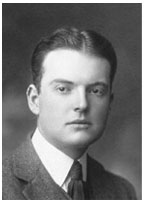 Edmund Wilson (photo to left), the great 20th century critic and writer, was close friends with F. Scott Fitzgerald. Yet of his close friend he said, in 1922, when Fitzgerald was only 26:
 Rainbow.” The book inspires