October 2nd, 2010
I’m a month into classes at Harvard as part of my Nieman fellowship. I meant to write about course-shopping from the get-go. It’s time.
Course shopping is Harvard’s version of musical chairs. In the first week, students stream in and out of courses in an effort to sample as broadly as possible from the wonderful intellectual cornucopia that is the Harvard course catalog.
I didn’t do much shopping. I walked out of one class partway through, mostly because I was pretty sure that I would pick a different course for that time slot, and the prof had started to read through her syllabus, which I could do on my own.
Because I wasn’t hopping from class to class, I found the week odd — in my experience, many professors don’t really teach anything, given their fickle audience. A number of the classes I took featured a kind of broad overview or a standard introductory lecture. Michael Parzen turned Statistics 104 into a stand-up routine, part of his promise that statistics will not be the course you hate the most while at Harvard. In my case, he may be wrong, but it won’t be his fault.
I’m interested in behavioral economics, but didn’t think I was quite up for the graduate level Psychology and Economics seminar taught by Andrei Shleifer and two others (I dearly want to take a course with Shleifer, but he’s teaching a less mathematically intense version of the course in the spring term, and that seemed to me to make more sense). So I opted for Cultural Econmics, Alberto Alesina’s look into how culture shapes economic behavior. I also wanted to read some Shakespeare, so I went to Stephen Greenblatt’s class on Shakespeare’s Tragedies (that class had the weirdest moment of course-shopping week — Greenblatt is a famous Shakespearean scholar, and yet the hall where he was lecturing was perhaps half full when he started. A lone student blundered in about 2 minutes later, and muttered ‘there’s a bunch of people outside.’ Greenblatt sent a teaching assistant out, and for the next five minutes, undergraduates poured into the hall, filling the place. So far, this makes for the only time I have questioned the intellectual abilities of Harvard undergraduates.)Harvard Business School doesn’t have the same kind of vibe during course shopping. But then, once you’ve crossed the River, you’ve entered a different world. Harvard starts all classes at 7 minutes past their official start time, so you can get from your course that ends at 11 to your course that starts at 11 without missing anything. The Business School starts on time. The Business School also plunges right into coursework. No introductory lectures here — you’d better have read your case study on day one and be prepared to answer questions.
Maybe it was the bracing bite of real intellectual engagement, but I loved the class at the Business School, Entrepreneurialism and Global Capitalism. It provides an excellent look at the first wave of globalization back in the 19th century, and how its events shaped the modern economy.
The business school also respects the calendar — the first day of classes, Wednesday September 1st, was indeed Wednesday. Not so on the other side of the Charles, where Wednesday was Monday. The last class I wanted to take meets only on Wednesdays, but didn’t meet on the 1st, since in Harvard land Wednesday was not Wednesday but Monday. (This apparently was done because the following Monday was Labor Day, and classes that meet only on Mondays would not have met for the first time until the second full week of classes). That class is a graduate-level seminar on Gravity’s Rainbow, taught by the polymathic Peter Galison. The Pynchon novel is very dense, but the course description was captivating. I can say that I’m already gaining a deeper appreciation for the novel (but I’m not recommending it; it says something when one needs an entire course to appreciate a novel).
I’m really delighted at the opportunity to be here.
Posted in Uncategorized, Nieman | No Comments »
September 20th, 2010
All the buzz out of Zeitgeist was that Google gave a bunch of people some great geek schwag.Yes, Google has money, and Zeitgeist schwag is vaguely reminiscent of Oscars’ schwag bags. I couldn’t have accepted the gifts even if I hadn’t left before they were handed out, but even so they were far from highlighting the event. Sadly for us journalists, everything at the conference starts out off-the-record. But given what’s gone up online at Google’s own Zeitgeist page, I would’ve thought we’d see something headier by now, a week afterwards. For instance, now publicly available at the Zeitgeist site is a session with former World Bank chieftain Jim Wolfensohn and Nouriel “I called the crash” Roubini. In this session is their discussion of the failure of both American-style laissez-faire capitalism and European-style social capitalism. What was remarkable to me about this statement is not that it got pronounced — it was a common comment in 2008 and 2009 — but that it didn’t get attacked. That a largely Western corporate crowd didn’t openly challenge an assertion that Western capitalism has failed says something important. (Granted, my mind was in part on the session I was preparing to emcee, so maybe I missed some rebuttal. If such occurred, it wasn’t with guns blazing.)
Overall, I found the conference was that rare event that got my adrenaline flowing. There were a few too many people wearing blazers for a self-proclaimed casual event (including a lot of Googlers). But really good approaches to the concept of change, fun ’surprise’ speakers, like professional origamist Robert Lang (his presentation is also up on the Zeitgeist site), and eclectic points of view. The session I emceed was called Catalyst. When people become catalysts, they’re brooking authorities of their day and place, making something new happen, revealing truths, righting wrongs, setting others on new paths. Tugging against entropy is not unique to humans, but the way we pursue it is unique, and how we pursuit it appeals to me strongly as a writer and a person. I found it wonderful to be amongst these catalysts, who remain nameless in part because I’m not sure who was on the record, and provocative.
Based on what I saw this year, if you ever get invited to Zeitgeist, go. And make sure not to leave early!
Posted in Trips, Speaking events | No Comments »
September 11th, 2010
Richard Morgan has this great post on his freelance life, Seven Years as a Freelance Writer, or, How to Make Vitamin Soup. Wise, warm and witty, it offers a cautionary look at the ups, downs and maddening misbehavior by editors and supposed friends that freelancers face.
Morgan is interviewed by Nieman Storyboard editor Andrea Pitzer (I found out about it from a talk Pitzer gave to us incoming Nieman Fellows last week). One salient exercpt:
There’s a part of The Awl piece where I describe it as “choosy begging.” People emphasize the choosy part when they fantasize about being a freelancer, and not the begging part. But there’s so much freelancing you have to do that’s just 300-word stories.
Current freelancers will get knowing grimaces — and grins — from Morgan. Aspiring freelancers should read him closely — he’s telling it like it is.
Posted in Nieman | No Comments »
September 6th, 2010
Modest, self-effacing and dead-on with his approach to media. That’s Adam Penenberg, who is now getting buzz for using Twitter to break a story, prompting mainstream media to pick up on it. Here’s a good run-down of why it matters, including an interview with Adam. Adam, glad to know ya!
Posted in Friends | No Comments »
August 30th, 2010
Catching up on some overdue posts… I interviewed Fred Brooks, a pioneering software thinker (and doer), for Computerworld.
Brooks may be old school, but his new book, The Design of Design, offers well-polished, concise essays that even the most egregious multitasker will be able to follow. We talked about some of his ideas in the Q&A, but there’s almost always good stuff that doesn’t make it. The last thing to go in this one were his comments about the state of writing amongst American-born graduate students in computer science:
We still get graduate students who have difficulty writing plain English paragraphs. I get some students with English as a second language who write better than some of my American students.
Writing something other than code still matters for programmers.
Posted in People, Writings | No Comments »
August 27th, 2010
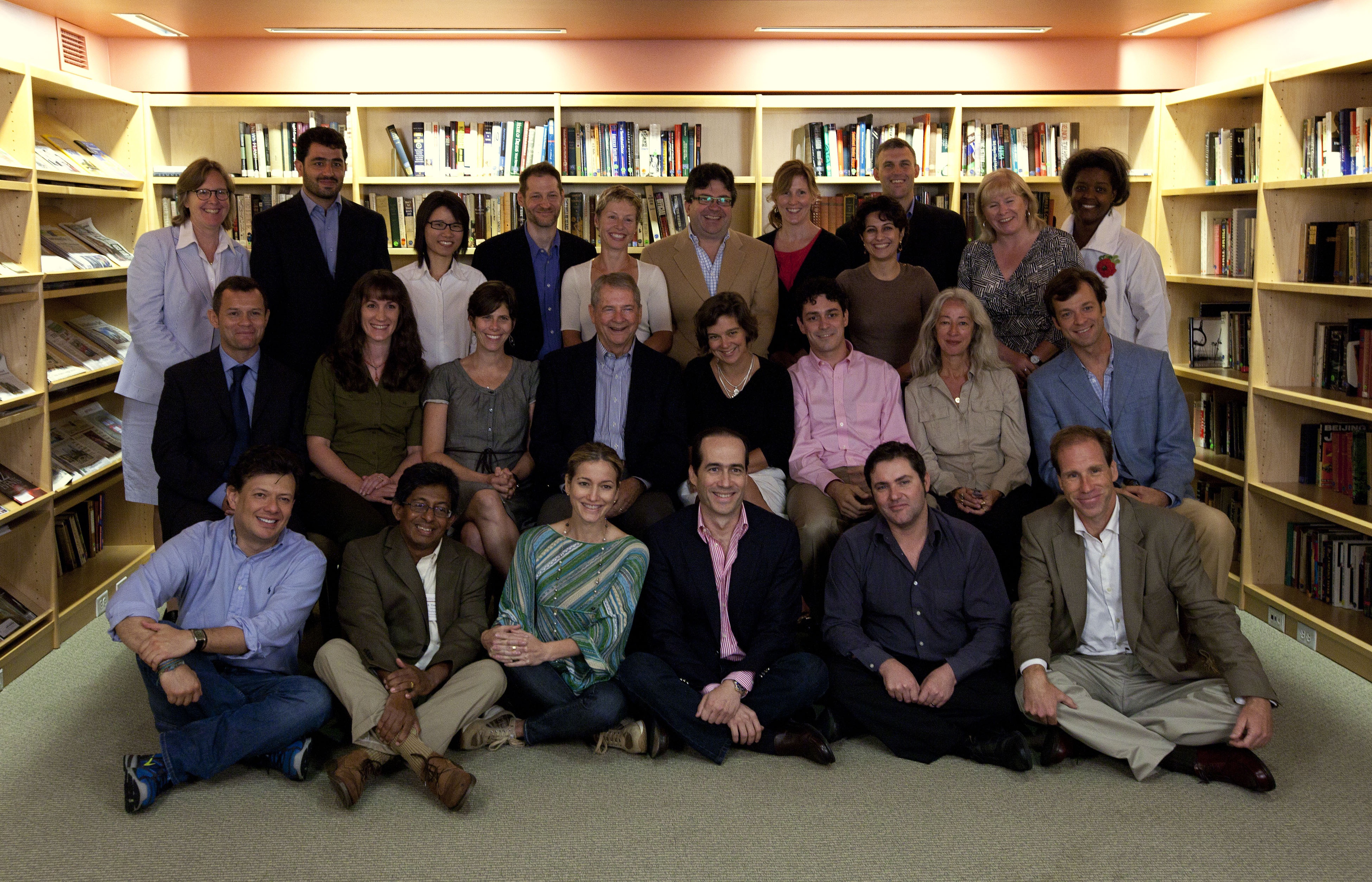
The Nieman class of 2011 (sans one, who was navigating treacherous visa waters).
We are a diverse group geographically, of course, and also professionally. Newspapers employ 15 of us, television five of us, radio one, two of us work in multiple media, one of us mostly writes books, and one of us is a photojournalist. Eight of us are freelance or independent.
Posted in People, Nieman | No Comments »
August 23rd, 2010
I haven’t posted in more than a month. I spent all that time selling a house in the exurbs and moving to an apartment in Cambridge. Economists grouse that people aren’t willing to move to where jobs are, but they discount the sheer human cost moving extracts from us. Between working and moving, I have had no time and less energy to do anything like post even a small item here on this blog.
The sale underscores why housing sales matter so much to the economy: for almost everyone, a house represents the most expensive thing we’ll ever buy or sell. Both buyer and seller write a lot of checks; as sellers, we spent thousands of dollars on landscaping, handyman services and painting, all to make the place look the best it could in a tough market (and it did look good). We also spent hundreds more on things like lawyer fees, various taxes and fees for things like changing our auto registration, our licenses, proving that our septic tank was still up to snuff (and getting it cleaned out). The excise tax at the end of the process was a couple of grand. The realtors, of course, split five percent of the sale price, a healthy fee even in the current economy, and our broker paid for advertising and other services as part of the selling process.
The buyers have to write lots of checks, too. Both of us will have to move, paying for moving boxes, movers and in our case storage for things we didn’t bring, but don’t want to have to pay to replace when we move to someplace bigger than our apartment. We paid for paint for the apartment (never mind why) and also asked for, and got, the washer and dryer replaced (why the previous tenants had tolerated a washer with a broken drum is beyond me). There are always unexpected expenses, too — somehow, my blue suit did not make the move. I’ll have to replace that; a man can’t be without a blue suit. Home sales touch wide swaths of the economy.
I’ll try to post more regularly again. I started my Nieman Fellowship today, and a year at Harvard may prove equally as time-consuming (I’m already doing homework and the school year hasn’t started yet). I met my fellow Fellows today, and am humbled to be among their number. What an incredible group of journalists!
Posted in Nieman | No Comments »
July 19th, 2010
The Onion published this trenchant bit of wit, Recession-plagued nation demands new bubble to invest in, back in 2008. It feels more true with time, as we see speculators piling into obvious markets (cash for gold, anyone?) and less obvious ones, like corn, as if indeed trying to find the next bubble. People have tried to speculate since the beginnings of markets (early economists fretted about the shift of investment from agriculture to trading companies, for instance). But I wonder whether we prefer it now as a source of profits. For instance, did derivatives change our appetite for speculation? Invented to manage risk, they get written about enough that they seem like cash cows for Wall Street firms and their wealthy clients. I sometimes mean to look for statistics on derivatives as a percentage of investment activity. Would the stats show that derivatives receive more investments than the useful things they’re derived from? If so, would that explain our seeming economic need for speculative bubbles? In the last fifteen years we’ve seen speculation infect the stock market, much of the major housing markets and commodity prices, quite obviously in oil, less so in basic foodstuffs like corn and even wheat.
I’m thinking about stat-hunting again after listening to an interview on NPR’s Here and Now with Frederick Kaufman on whether Wall Street caused the 2008 food riots in various parts of the world. Kaufman wrote a Harper’s article, which I’ve not yet read, arguing that Goldman Sachs and other Wall Street firms used a wheat commodities index to drive speculation in the food markets. NPR notes a Goldman Sachs rebuttal saying the commodities index fund it created in 1991 built pools of risk capital for wheat farmers to tap. Kaufman is having none of that, though I’m not sure he makes his case, or even could in a relatively brief radio interview. Goldman is certainly correct about the intent of such funds, but that doesn’t make Kaufman wrong in saying that such intent can be corrupted. Kaufman in the end calls for a return to “a much older way of doing things,” setting up a grain reserve to offset the kind of speculation that we saw in the wheat markets. Perhaps that would work, though U.S. oil reserves did little to dampen the incredible speculation in the oil markets in the same period.
I recently interviewed a historian named Mark Valeri, who thinks going back to a time before national grain reserves would be more helpful. His book Heavenly Merchandize looks at how markets emerged in the pre-Revolutionary America. He 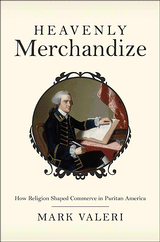 shows that markets were created in a time where people were more connected with those around them, and there were expectations that those who made markets would use them not just for their own gain, but with the understanding that they needed to behave in ways that did not damage the broader society, and especially the poor. Valeri shows that it took about 120 years for those ideas to be subsumed and the market came to be seen as having a natural order separate from the personalities of the people within it. Even then, those in the market aimed to behave in ways that were not good only for themselves and accepted what would seem to us like excessive regulation. That ethos sounds quaint.
Or maybe I just have sour grapes. Having sold our house for 22 percent less than we paid for it five years ago, I feel personally poorer for derivative-driven market speculation. I knew, even without knowing about CDOs, that my house wasn’t worth what the market said at the time, and likely wouldn’t be for a long time to come. But I expected we would be in the house for that long time. I didn’t plan on a big new opportunity to arise that would cause me to want to sell the house sooner rather than later. So perhaps I’m feeling a bit sorry for myself, like I transferred wealth to someone at WAMU five years ago, and now can’t get it back. Gads. I’m sounding like I buy into Lester Thurow’s Zero-Sum Society concept, twenty years later. That’s profoundly negative of me. I really should go dig up those stats.
Posted in Uncategorized | No Comments »
July 14th, 2010
I always thought Michiganders who weren’t Yoopers spoke in pretty much the same made-for-TV flatness of Nebraskans (the ideal TV accent to have, I read once). But all these things listed in The Michigan Accent ring true. I would add two words. If you’re going to put in the Big Beev, anyone who knows Port Huron will tell you have to add Gratiot, as in old Fort Gratiot, pronounced as if the grass were fertilizing itself. I also happened to live ‘Outstate,’ meaning all of Michigan outside the loose semi-circle from Port Huron to Ann Arbor to Midland (or so).
Posted in Uncategorized | 1 Comment »
July 13th, 2010
The Harvard Crimson’s Cici Yu has a good write-through on the Hollman Morris visa fiasco. Nieman curator Bob Giles has some good points about how the U.S. should want this guy here. The Obama administration look like dupes; they’re okay with Morris in 2008, and now he’s a terrorist?
Posted in Uncategorized, Nieman | No Comments »